Windows Media Player Playlist Location Windows 10
Windows Media Player Plus - Free Download for Windows 10 64 bit / 32 bit Download Windows Media Player Plus latest version 2019 free for windows 10, 8, 8.1 and 7 Setup installer 64 bit, 32 bit. Free plug-in for Windows Media Player that adds various user interface and playback enhancements.

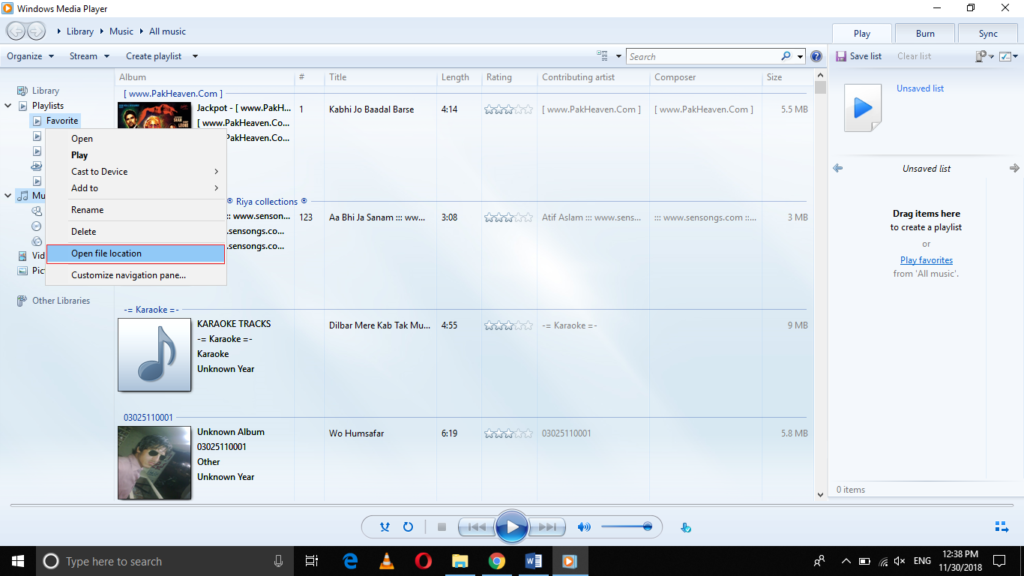
- Aug 15, 2010 Let’s say you have just created a Playlist in Windows Media Player 12 but can’t find the WPL file in the “My Music” folder, then the Windows 7 Music Library default saved location should have been changed to something else. To confirm that is the culprit, open Windows Explorer, click Music Library and then the “locations” link.
- I lost my C: drive and I have a backup but I don't know where the data is except that it's supposed to be stored with the user. Source(s): windows media player 10 library location: Anonymous 3 years ago.
As you may already know, Windows Media Player 12 becomes an optional feature with recent updates to the final version of Windows 10 Fall Creators Update. The app gets removed automatically, so you might want to restore it back in the OS. In this article, we will see how it can be done.
RECOMMENDED: Click here to fix Windows errors and optimize system performance
Windows Media Player was bundled with Windows for a long time. Starting with Windows 98, every new version of Windows came with an improved version of the app. Windows Me was the first OS where Windows Media Player got a media library, skins and visualizations. The Windows XP era was when there were several updates to Windows Media Player, starting from version 8 to version 10. Windows Vista brought Windows Media Player 11, and Windows 7 brought version 12.Besides local playback of audio and video content stored on your drive, the player also features integration with the OS Libraries, metadata, ratings and album art management and can handle Internet streams with multicast. It can play media with fast forward, reverse, file markers (if present) and variable playback speed. WMP can also be used to sync content on devices which support Media Transfer Protocol, legally rip audio CDs, or burn a disc. It has a graphic equalizer, subtitle and caption support, plugins which support DSP effects, crossfading and auto volume leveling, auto-playlists and remote control features. Full keyboard-based operation is possible in the player. For video formats, WMP includes universal brightness, contrast, saturation and hue adjustments and pixel aspect ratio control. DVD playback was supported in Windows 7's version of WMP but removed later.
Windows 10 comes with Windows Media Player 12, but it has been improved upon in various ways. Support for FLAC audio, MKV container format and HEVC video was added. Support for the latest IDv3 tag standard for MP3s was also added. Also, the Play To feature was replaced by a greatly improved (Cast To feature) which can use either DLNA or Miracast to stream content to smart TVs and other devices and is more robust and compatible.
In recent Windows versions such as Windows 10, Windows Media Player is not the default app any more because it is not based on UWP. In Windows 10, Groove Music is the new default music player app and Movies & TV is set as the default video player app.
Windows Media Player Playlist Location
If you are extremely unhappy with Windows Media Player's removal, here is what you can do to restore it.
To restore Windows Media Player in Windows 10, do the following.
- Open the Settings app.
- Go to Apps > Apps & features.
- On the right, click on the link Manage optional features.
- Click on the button Add a feature at the top of the next page.
- Find the optional feature named Windows Media Player in the list under Add a feature.
- Click it. The install button will appear as shown below. Click on the Install button and you are done.
Tip: Using this method, you can also remove Windows Media Player from Windows 10. This will free up around 60 MB of space on the system drive - not much. In Settings > Apps > Apps & features > Manage optional features page, select Windows Media Player and click Uninstall to remove it from the OS.
There is an alternative method to add or remove Windows Media Player in Windows 10. It can be done with PowerShell. Here is how.
Restore Windows Media Player in Windows 10 using PowerShell
- Open an elevated PowerShell.
- To restore Windows Media Player, use the following command:
- To remove Windows Media Player, use the following command:
That's it.
RECOMMENDED: Click here to fix Windows errors and optimize system performance
Windows Media Player is still one of the best tools for playing music and movies, but it does have its own share of problems that pop up now and again. Most issues with the Windows Media Player tool are easily fixed, just like this one. The problem we’re going to talk about today is the one that affects media files such as .3gp, .3g2, .mp4, .mov, and .adts. You see, whenever any of these media files have a space in their path or file name, users will experience the following error:
Windows Media Player cannot play the file, The player might not support the file type or might not support the codec that was used to compress the file.
Don’t freak out because this error only comes up when Internet Explorer uses a URL encoded path to call the CreateProcess. Now, since Windows Media Player itself is not capable of opening a URL-encoded path, it shows an error instead.
Read: How to download & install codec on Windows 10.
Windows Media Player cannot play the file
First, we must install the latest updates
A lot of problems folks are experiencing with Windows 10 is due to their failure of updating their computer on a regular basis. To get the updates, visit the Microsoft Update and install all the latest updates for your system. You may want also to ensure that your Sound and other drivers, as well as your Codec files, are updated.
That should do the trick, but if for some odd reason it doesn’t, well, the following tip should straighten things out, though it’ll require more work on the part of the user.
The workarounds
1] If there are spaces in the name of your media files or the path of the files, you should remove them promptly. That may help.
2] If your media files are not in a Windows Media Player playlist, then go ahead and create it.
To create a playlist, please fire up the Windows Media Player software, then click the button that says Playlist in the left-pane. Finally, you’ll see the option that says “Click here to create a playlist.” Do that, then add your music.
Alternatively, you may see an Unsaved list on the right-pane. Just drag and drop your music there and right away you’ll have a new playlist.
All the best!
Related read: Windows Media Player encountered a problem while playing the file.
Related Posts: